Your first injection: what you need to know
If you have just received your first Mounjaro KwikPen or a semaglutide injector, it is normal to feel some apprehension. The good news is that the needles used with GLP-1 medications are extremely fine, typically 31 or 32 gauge, making them virtually painless for most people. Many patients compare the sensation to a small pinch that lasts less than a second.
Before injecting, make sure the medication has been at room temperature for at least 30 minutes if you store it in the refrigerator. Injecting a cold liquid can increase discomfort and cause a slight stinging sensation at the site. Wash your hands with soap and water and prepare an alcohol swab to clean the injection area. There is no need to create an air bubble or prime the KwikPen as with conventional insulin pens: the KwikPen click mechanism takes care of dosing correctly.
Recommended injection sites
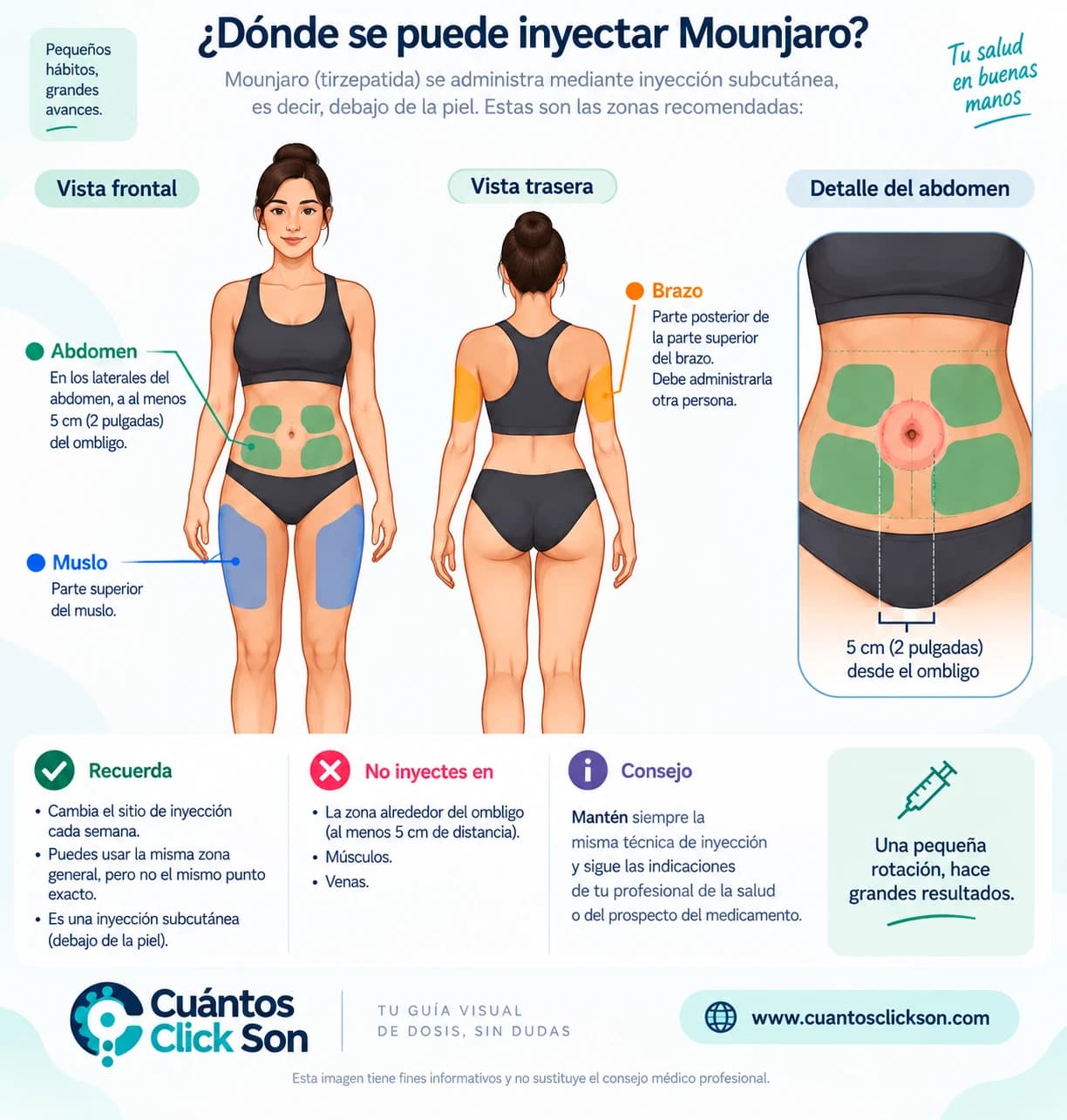
Injectable GLP-1 agonists such as Mounjaro and Ozempic are administered subcutaneously, meaning into the fat layer just beneath the skin. There are three main sites recommended by manufacturers and healthcare professionals for safe and comfortable injection.
- Abdomen: This is the most popular site among users. Inject at least five centimeters away from the navel, avoiding scars, moles, or areas with irritation. Absorption in this area tends to be consistent and predictable, making it the preferred choice for most patients seeking uniform results between injections.
- Upper thigh: Ideal if you prefer a site with more fatty tissue or if the abdominal area is sensitive from previous injections. Inject in the front of the thigh, approximately in the middle third, avoiding the knee and groin.
- Back of the arm: Less accessible without help, but it is a good alternative when you need to rotate injection sites. Ask someone to help you if you cannot comfortably reach the back of your arm on your own.
Common myth: injections hurt a lot
One of the most widespread myths among those starting GLP-1 treatment is that the injections are painful. In reality, the vast majority of patients describe the experience as surprisingly painless. The modern needles used with the KwikPen and similar devices are extremely short, only four to five millimeters, and so fine that many people do not even feel them penetrate the skin. The most common discomfort is not the needle itself, but a mild pressure sensation or slight stinging during the first few seconds after injection, which quickly subsides.
If you feel anxious, you can apply an ice cube to the area for about thirty seconds before injecting to slightly numb the skin. Another useful trick is to inject slowly, counting each click of the pen at a steady pace, which reduces the sensation of pressure under the skin. Over the weeks, most patients say the process becomes a simple routine that causes them no concern.
How do GLP-1 medications work?
GLP-1 receptor agonists, such as tirzepatide found in Mounjaro and semaglutide in Ozempic and Wegovy, mimic the action of a natural hormone called glucagon-like peptide-1. This hormone is released in the gut after eating and performs multiple functions in the body: it stimulates insulin secretion when blood sugar levels are elevated, inhibits the release of glucagon (the hormone that raises blood sugar), and slows gastric emptying, which keeps food in the stomach longer.
Mounjaro is special because it acts as a dual agonist: it not only activates GLP-1 receptors but also GIP receptors, another gut hormone involved in glucose and fat metabolism. This dual mechanism of action is what has demonstrated greater efficacy in reducing body weight compared to single GLP-1 agonists in clinical studies. In the SURMOUNT clinical trials, patients treated with tirzepatide at the highest dose achieved an average weight loss of up to twenty-two percent of body weight, an unprecedented result for a weekly injectable medication.
The first weeks of treatment
The first four weeks on a GLP-1 medication are an adjustment period for both your body and your habits. Most treatments start with the lowest available dose, for example 2.5 mg in the case of Mounjaro, and it is maintained for at least four weeks before considering an increase. This gradual approach is not medical whim: it allows your body to progressively adapt to the medication and significantly reduces the incidence of gastrointestinal side effects.
During these first weeks, it is common to notice a fairly marked reduction in appetite. Many people describe simply forgetting to eat or feeling full with much smaller portions than usual. It is important not to interpret this as a signal to skip meals entirely: your body needs nutrients, especially protein, to maintain muscle mass and overall health while losing weight.
The most common side effects during the first weeks include mild nausea, gas, bloating, and in some cases, episodes of constipation or diarrhea. These symptoms are usually temporary and tend to improve considerably after the first two or three injections. If nausea is particularly bothersome, eating small, frequent portions instead of large meals can help enormously. Avoiding fatty, fried foods and heavily processed sweets also reduces the likelihood of experiencing stomach discomfort.
The importance of protein
When you are losing weight with a GLP-1 medication, your body does not perfectly distinguish between fat and muscle when seeking energy. Without adequate protein intake, you risk losing lean muscle mass along with fat, which can affect your basal metabolic rate over the long term and your functional strength. Nutrition professionals recommend consuming between 1.2 and 1.6 grams of protein per kilogram of ideal body weight per day while on GLP-1 agonist treatment.
Recommended protein sources include skinless chicken and turkey, fish such as salmon, hake, and tuna, eggs, legumes, tofu, Greek yogurt, and low-fat cottage cheese. If you struggle to meet your protein goal through food due to reduced appetite, protein shakes can be a useful supplement, especially as breakfast or a snack. Prioritize protein at every meal: always start with protein before moving on to vegetables and finally carbohydrates.
Exercise during treatment
Physical exercise is a fundamental complement to GLP-1 treatment that enhances both weight loss and the preservation of muscle mass. However, it is important to adapt the intensity to your current fitness level and to the changes your body experiences during treatment. Do not try to start an intense exercise program at the same time you begin the medication: your body is already adapting to the hormonal and metabolic changes.
For beginners, walking for thirty to forty-five minutes a day is an excellent starting point. As you feel more comfortable, progressively incorporate resistance training two or three times a week. Exercises such as squats, push-ups, resistance band rows, and lightweight dumbbell deadlifts are especially beneficial for maintaining muscle mass during weight loss. Yoga and Pilates are also valuable options that combine strength, flexibility, and mental well-being.
Stay well hydrated during exercise, as GLP-1 medications can reduce your natural sense of thirst. Always carry water with you and drink regularly even if you do not feel thirsty. If you experience dizziness, intense fatigue, or nausea during exercise, reduce the intensity and consult your doctor before continuing.
Side effects: what to expect and when to worry
The most common side effects of GLP-1 medications are gastrointestinal in nature and are usually mild to moderate. Nausea affects approximately forty percent of patients during the first weeks but decreases significantly over time. Constipation, diarrhea, bloating, and gas are also common at the start of treatment.
There are effective strategies to minimize these effects. Eat slowly and chew your food thoroughly. Avoid lying down immediately after eating. Reduce portion sizes and eat more frequently. Ginger, both as a tea and in natural candies, can relieve nausea. Gradually increase your fiber intake and drink at least two liters of water per day to prevent constipation.
However, some symptoms require immediate medical attention. If you experience severe and persistent abdominal pain, continuous vomiting that prevents you from retaining fluids, signs of dehydration such as very dark urine or severe dizziness, intense pain in the upper abdomen radiating to the back, or sudden visual changes, contact your doctor or go to the emergency room without delay. These symptoms are infrequent but may indicate complications that require urgent professional evaluation.
Plateaus and dose increases
It is completely normal to experience weight loss plateaus during GLP-1 treatment. A plateau is defined as a period of three to four weeks or more without significant changes in weight despite maintaining good eating and exercise habits. These plateaus can occur for multiple reasons: your metabolism adapts to the new weight, fluid retention can mask fat loss, or your body may be recomposing fatty tissue into muscle mass if you regularly do strength training.
Before requesting a dose increase, honestly review your eating and exercise habits. Sometimes plateaus coincide with an unconscious relaxation of habits. If after four weeks your doctor considers an increase appropriate, it will follow the medication titration schedule, which in the case of Mounjaro goes from 2.5 to 5, then to 7.5, 10, 12.5, and finally to 15 mg as the maximum dose.
Expected weight loss
Results vary significantly between individuals, but clinical studies provide a useful frame of reference. With Mounjaro at the highest dose of 15 mg, the SURMOUNT trials showed an average weight loss of twenty-two percent of body weight over seventy-two weeks. With semaglutide 2.4 mg from the STEP study, the average loss was approximately fifteen percent of body weight over sixty-eight weeks.
It is important to have realistic expectations and remember that these are averages. Some people may lose more and others less. The rate of weight loss also varies: it is typical to lose between half a kilogram and one kilogram per week during active titration phases, with plateau periods in between. Weight loss is not linear but follows a stepped pattern with accelerations and pauses. Measuring your progress solely with the scale can be frustrating: also consider measuring your waist, hips, and taking periodic photos to visualize changes in body composition.
Dose planning with the calculator
If your doctor has prescribed a personalized Mounjaro dose different from the standard dose for your pen, our calculator lets you know exactly how many clicks you need on your KwikPen. This is especially useful when transitioning between doses or when your doctor has instructed you to split the weekly dose into two smaller injections to reduce side effects.
Remember that each KwikPen contains 240 total clicks divided into 4 standard doses of 60 clicks each. If you use a personalized dose lower than the standard, you will get more injections from each pen, which can be relevant for both the financial planning and logistics of your treatment. The calculator also shows you the estimated duration of each pen based on your personalized dose.
A note about pharmacies and supply
Depending on your country and the current supply situation, there may be periods of shortage for certain KwikPen concentrations. It is advisable to maintain regular communication with your usual pharmacy to anticipate potential stock issues. Some pharmacies offer reservation or notification services when a specific medication becomes available again. If you experience difficulty obtaining your medication, consult your doctor about temporary alternatives or adjustments to the treatment plan.
Frequently asked questions
Can I drink alcohol while taking a GLP-1?
It is not absolutely contraindicated, but alcohol can worsen nausea and the gastrointestinal effects of the medication. Additionally, alcohol contains empty calories that can slow your progress. If you choose to drink, do so in moderation, choose low-sugar options, and avoid drinking on an empty stomach. Many patients notice that their alcohol tolerance decreases significantly with treatment.
What happens if I miss an injection?
If fewer than four days have passed since the scheduled date, administer the injection as soon as possible and continue with your normal schedule. If more than four days have passed, skip that dose and wait for the next scheduled date. Do not double the dose to make up for a missed injection. To avoid forgetting, set a weekly alarm on your phone always at the same time and day.
Do I need to follow a specific diet?
There is no mandatory diet, but there are recommendations that optimize results. Prioritize lean proteins at every meal, consume plenty of vegetables, choose whole grain carbohydrates, and avoid ultra-processed foods, fried foods, and added sugars. Eat slowly, chew well, and stop when you feel full. The natural appetite reduction produced by the medication will help you consume fewer calories spontaneously, without needing to obsessively count every calorie.
How long does treatment last?
GLP-1 treatment is usually long-term. Studies show that most patients regain some of the lost weight if they discontinue the medication. Your doctor will assess the treatment duration with you based on your weight goals, your metabolic health, and your individual response to the medication. Some patients may gradually reduce the dose once they reach their goal, while others may need an indefinite maintenance dose.
Can I do intense exercise while on treatment?
Yes, but start progressively. Strength training is especially recommended to preserve muscle mass. If you were already athletic before starting treatment, you may notice a slight reduction in performance during the first weeks while your body adjusts to the lower caloric intake. Make sure to consume enough protein and calories to support your activity level.
Are the results permanent?
Changes in body composition can be lasting if you maintain the healthy habits acquired during treatment. However, GLP-1 medications do not cure obesity: they treat it. If you stop the medication without having consolidated deep changes in your lifestyle, there is a significant risk of regaining weight. That is why many professionals consider these medications as a chronic treatment similar to drugs for hypertension or diabetes.